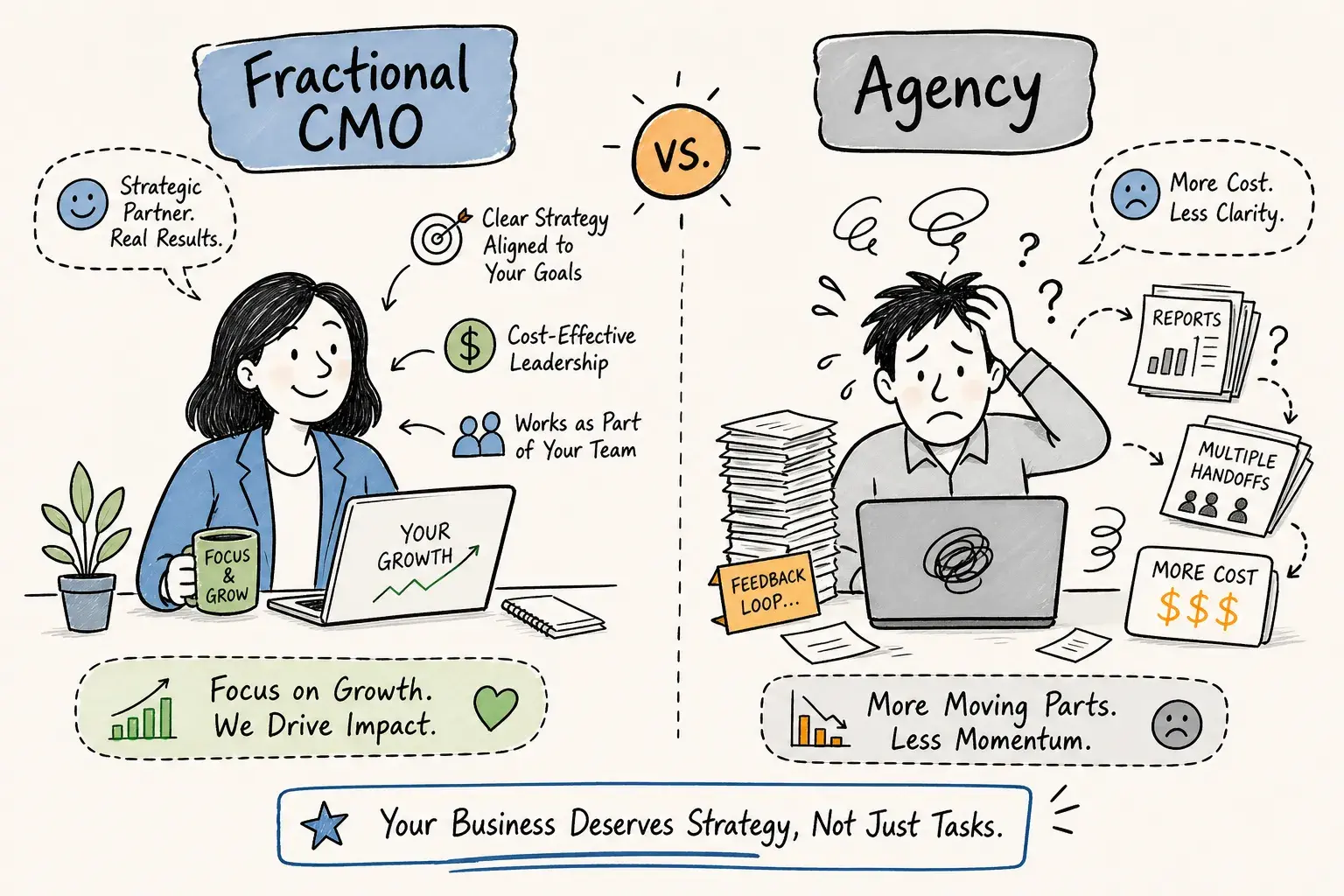
Hire a Fractional CMO: The Practical Australian Checklist

Most businesses get the fractional CMO hire wrong before the first interview. They treat it like a contractor role, ask surface questions about industry experience, and skip the structural work that actually makes the engagement land. By month three the retainer's gone, the relationship's tense, and the owner is wondering what happened.
This checklist exists to stop that. It covers how to tell whether your business is ready, the four things worth evaluating a candidate on, the interview questions that separate practitioners from theorists, what fair Australian contract terms look like, and a 30/60/90-day onboarding plan you can use from day one.
Work through it in order. Each step builds on the one before it, so skipping ahead usually means coming back to the same problem later.
Is your business actually ready for one?
A fractional CMO is not a fix for a business that hasn't worked out what it sells or who it sells to.
The model works when you already have traction, a functioning sales process, and marketing spend in motion but producing inconsistent results. If your revenue sits between $500K and $5M, you're spending more than $5,000 a month on marketing, and the founder is the de facto CMO on top of running everything else, that's the profile that gets the most out of a part-time arrangement.
Readiness also means being willing to hand marketing decisions to a senior practitioner and trust the process. A fractional CMO can't do their best work if every recommendation needs three rounds of approval, or if someone on the leadership team is quietly working against the strategy. In practice: nominate one internal decision-maker and agree a sensible turnaround on approvals before the engagement starts.
There are times the hire creates friction instead of progress. Bringing someone in too early, before product-market fit or before there's a team to lead, adds cost without adding clarity. Expecting measurable pipeline inside 60 days is the same mistake from the other direction. The first month is discovery, not delivery. Any engagement that skips that step is skipping the work that makes the rest succeed.
The four-point candidate evaluation
Real execution experience, not just credentials
This is where most businesses trip first: confusing credentials with capability.
You're not just looking for category experience. You want evidence the candidate has personally run the tactics, not only managed the people who ran them. Have they built a landing page, pulled an ad report, written the emails, sat on a sales call? The model works best when the practitioner has operated at the execution level, not directed from above it.
That's how I work. I've run the ads, built the funnels, and made the calls myself, which means every recommendation comes from having done it, not from theory. That distinction matters when you're paying for senior marketing leadership without the senior marketing salary.
If you're in a specific category, aesthetic clinics or appearance-focused service businesses for example, there are sector considerations worth raising during evaluation. Read our marketing your aesthetic business
A discovery-first approach, treated as non-negotiable
Any candidate who turns up to the first conversation with a ready-made solution hasn't earned the right to propose one.
A real discovery approach looks like structured stakeholder interviews, a proper go-to-market audit, and a formal gap-analysis readout to leadership before any strategy gets recommended. Working out what's actually wrong before writing the prescription is the clearest signal you're hiring a thinking partner, not a vendor selling templates.
Measurement tied to revenue, not vanity metrics
The right candidate connects every activity to pipeline, CAC payback, and LTV:CAC. They're not there to report impressions and click-through rates. They build accountability around revenue attribution and qualified pipeline coverage.
Ask it directly: what do you use to judge whether marketing is actually working? The answer tells you most of what you need to know.
Honest availability
Ask how many clients they're currently running and what their weekly availability looks like across those commitments. Vague answers about being flexible are a red flag. A good candidate gives you a number and explains how they protect client time. If the roster's already stretched, your work competes for attention from day one.
The interview questions that do the work
Five questions carry most of the load. Ask each one and listen for specifics, not confidence.
- Walk me through your 30-day diagnostic process for a new client.
- How hands-on are you in execution, specifically ads, landing pages, and email?
- What business outcomes do you believe marketing should own?
- How do you decide where to invest budget and where to cut?
- What conditions make a fractional engagement fail?
Strong answers are specific. The candidate names real tools, real metrics, real tradeoffs. They talk about a campaign they personally changed mid-flight and why. They can name the conditions that make these engagements fail, and they're honest about what the client side has to bring.
Weak answers are generic. Frameworks and philosophy with no execution underneath. What good marketing looks like in the abstract, rather than what they've personally delivered. If an answer sounds like it came from a textbook, push harder or move on.
A few red flags should end the conversation early. Pattern-matching an old solution onto your business without understanding it first is the most common. So is being unable to cite specific numbers from past work, or launching into a tactical pitch before asking a single question about how your business runs. The right practitioner works out what's wrong before recommending the fix. Every time.
For more angles to test candidates against, compare their answers to a published interview-questions list. It helps you tell rehearsed talking points from real operational ones. Fractional CMO interview questions.
What fair contract terms look like in Australia
Australian fractional CMO engagements typically run at hourly rates of $250 to $450 and monthly retainers between $5,000 and $18,000, depending on scope and days committed. A full-time Australian CMO often clears $300,000 in base salary alone, before super and bonuses. The fractional model delivers the leadership at roughly 60 to 70 per cent less cost. That's the core of it.
Longer commitments of 12 months or more often attract a 10 to 15 per cent discount on the monthly rate. If you're confident in the fit after the pilot, raise it before signing the extended term. Frame it as mutual commitment: you're reducing their client acquisition risk, and the discount reflects that.
Before you sign, understand these five clauses.
- Initial term. Three to six months as a pilot, with defined performance milestones.
- Notice period. 30 to 60 days after the initial term is standard, with 30 the most negotiable.
- IP ownership. Transfers 100 per cent to you. Every framework, dashboard and document produced during the engagement belongs to your business.
- Scope of deliverables. Explicit, not described in general terms.
- Transition plan. A mandatory clause that protects you if it ends. It requires the CMO to document ongoing projects, vendor relationships and strategy context before they leave.
The 30/60/90-day onboarding plan
Days 1 to 30: discovery, audit, gap analysis
The first month isn't about output. It's about understanding.
It starts with structured stakeholder interviews across founders and sales leadership, then customer interviews to check the buying journey and value proposition hold up. The go-to-market audit covers the ideal customer profile, messaging, active channel performance, pipeline data, and competitive positioning. The month closes with a formal gap-analysis readout to leadership.
Any fractional CMO pushing to launch campaigns in week two is skipping the work that makes campaigns succeed. That readout at the end of month one should be the single most valuable document of the engagement. It tells you where the business actually is, where the gaps are, and what deserves attention first. 30/60/90-day plan template
Days 31 to 60: strategy, quick wins, momentum
The second month moves from understanding to building.
The 90-day go-to-market roadmap goes on paper: priority channels, campaign hypotheses, weekly checkpoints, measurable pipeline targets. A positioning and messaging framework comes out of a structured workshop with leadership. One or two quick wins spotted during discovery get launched, a sharper ad targeting approach, an email nurture sequence, a landing page that actually reflects the offer.
Channel selection stays pragmatic. Pick the channels the audit points to, not the ones that are fashionable. By day 60 your cost per qualified lead should be settling, campaign data should be flowing, and the team should have a clear view of what's being tested and why.
Days 61 to 90: implementation, visibility, optimisation
The final month is execution and accountability.
Two or three campaigns run against the approved roadmap. The first version of a live performance dashboard goes up, giving leadership honest visibility into what's working. Weekly operational reviews and monthly strategic deep-dives become the cadence, and that cadence holds for the rest of the engagement.
By day 90 the standard is clear: a validated strategy on paper, a live dashboard, and early pipeline from tested channel bets. The numbers to watch are marketing-sourced pipeline, cost per qualified lead, lead-to-opportunity conversion, and CAC efficiency. If those aren't moving the right way by day 90, the strategy needs a frank review, not more time to breathe.
Use this as your filter
The thread running through all of it is accountability. Yours as the owner, and theirs as the practitioner you're bringing in.
A fractional CMO engagement works when the hiring process is as rigorous as the strategy you're hiring them to build. Readiness assessed honestly. Candidates filtered on execution experience and diagnostic discipline. Contract terms locked before the work starts. And 30/60/90-day milestones that hold both sides to a clear standard.
If you're working through this and want a straight conversation about whether a fractional CMO is the right next move, LYL Marketing runs an initial discovery session. Bring your questions. We'll tell you what we actually think.
Explore More Insights
Discover related articles for deeper understanding.