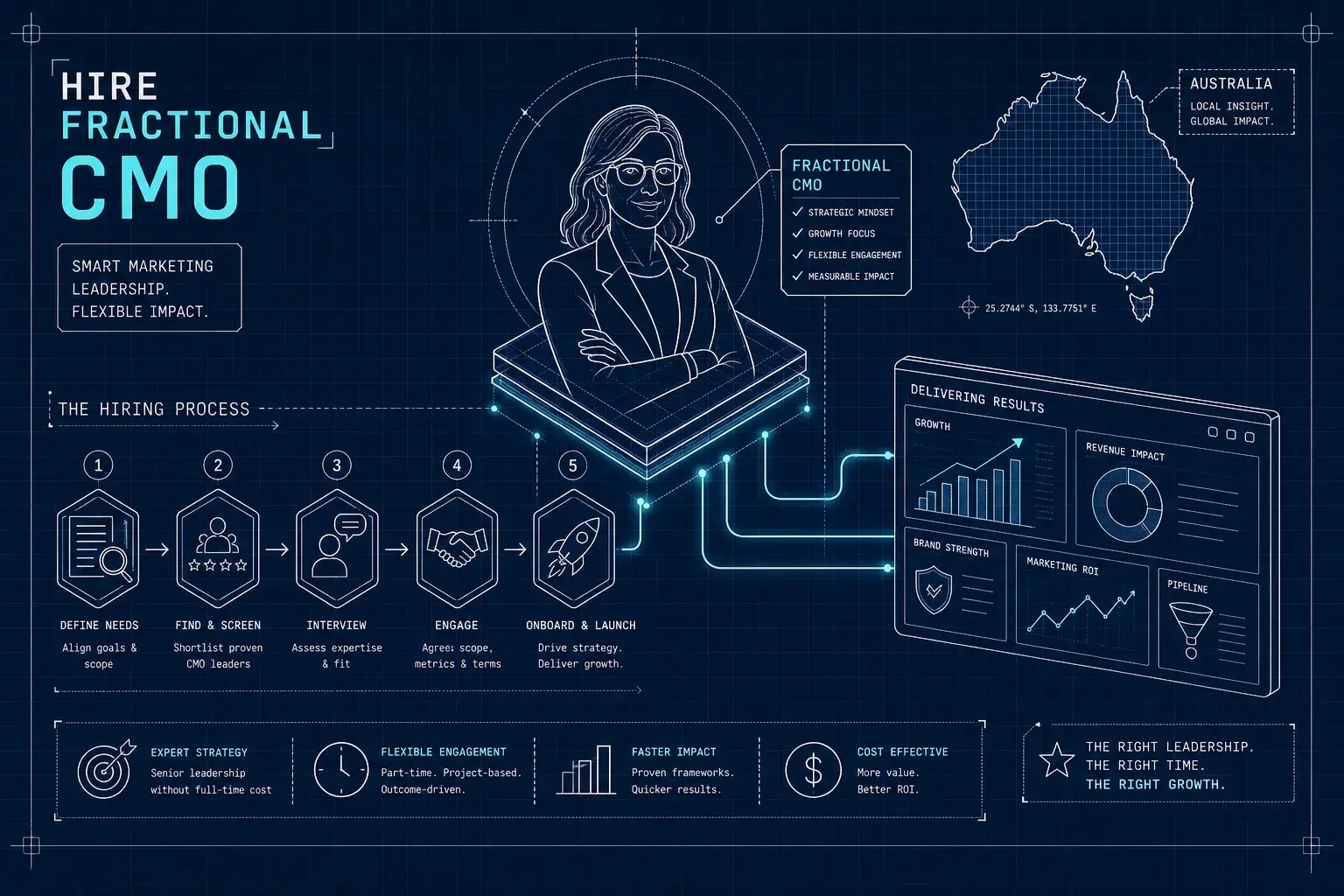
Fractional CMO vs Marketing Agency: The Real Difference for SMBs
Most founders weighing up a fractional CMO vs an agency check the price first, then work out what they're buying. That order is backwards, and it's expensive.
The question isn't which one. It's what problem you're actually solving. The two models solve different problems, and using one to fix the other's problem is one of the most common ways marketing budgets get burned in Australian SMBs.
I run an embedded, single-practitioner model at LYL Marketing. That sits in its own category, apart from traditional agencies and apart from a full-time executive hire. Here's the straight breakdown.
Fractional CMO vs agency: what you're actually paying for
Both involve paying a marketing professional every month. That's where the similarity ends.
An agency sells execution capacity. Ads, content, campaign reports, landing pages. Tangible output. The quality of that output depends entirely on the quality of the brief it receives. Without direction, execution becomes expensive guesswork.
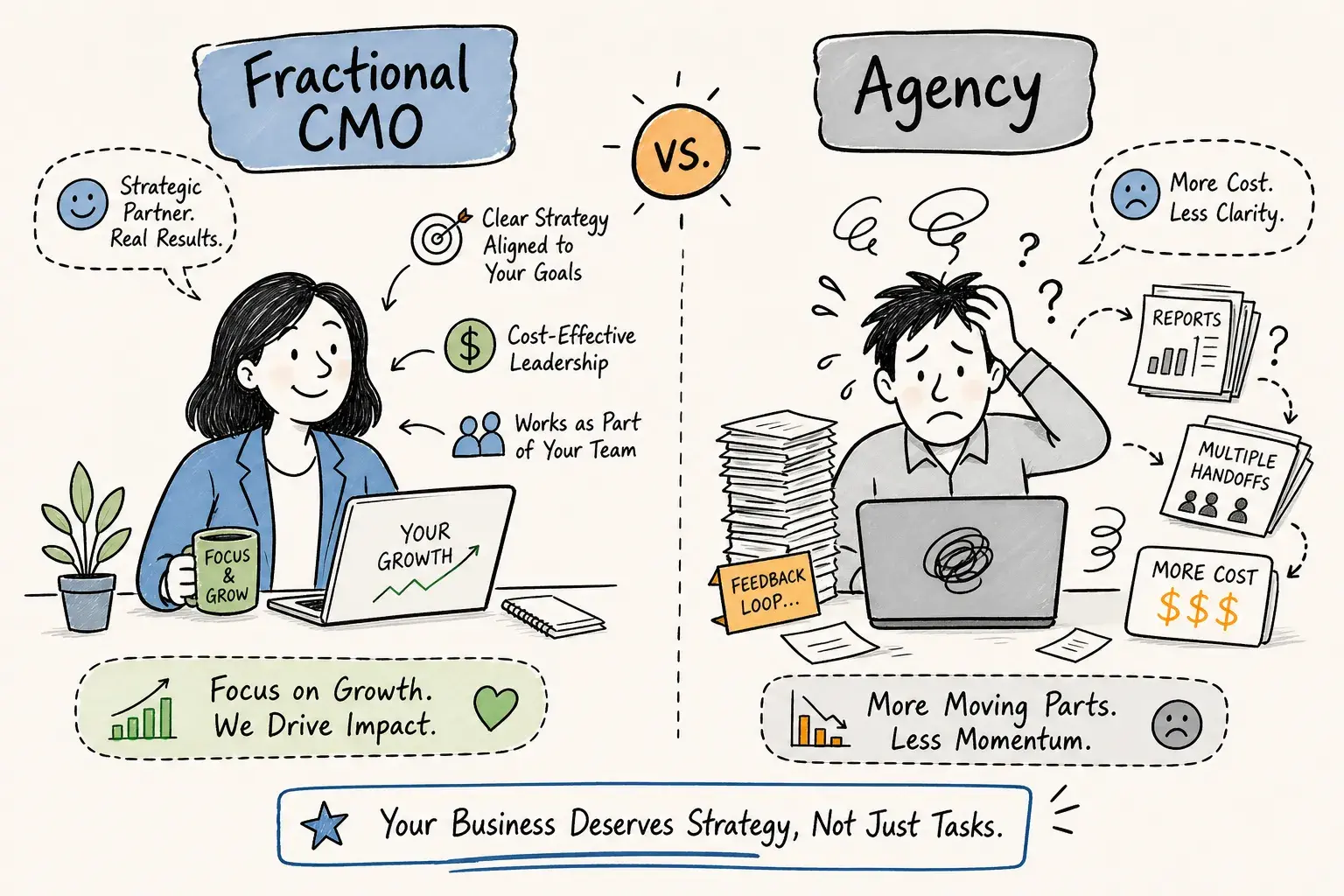
A fractional CMO sells strategic ownership. Part-time marketing leader, not a vendor. Owns the strategy, sets the priorities, defines the KPIs, and manages whichever agencies and tools you're already paying for. Doesn't produce the deliverables. Makes sure every dollar spent on execution is pointed somewhere sensible.
Agencies aren't the problem. Execution without strategy is. Most Australian SMBs who feel their marketing isn't working aren't failing at execution. They're failing at the layer above it, and sharper ads won't fix that.
Who owns the strategy, and the outcome
This is the part agency sales conversations tend to walk around.
An agency contract is built on outputs. Posts published, campaigns launched, enquiries through a given channel. When results fall short, they can point at the deliverables and say they held up their end. Strategy misalignment becomes your problem. That's not a criticism of agencies. It's structural.
A fractional CMO doesn't report on activity. They report on revenue, pipeline, cost per acquisition, and what marketing contributed to the business. If the strategy is wrong, that's theirs to fix. They manage the agencies, not the other way around, and they're measured against quarterly outcomes tied to agreed business goals rather than deliverable counts. Key responsibilities of a fractional CMO
In practice that means sitting in leadership meetings, being inside budget decisions, and changing the strategy when performance says to. Any IP, frameworks and dashboards built during the engagement belong to the client from day one. In an agency relationship you hold the risk on strategy while they keep ownership of their methods. That asymmetry matters most when things aren't working.
What outsourced marketing leadership costs
Real figures, not ranges wide enough to avoid the question.
Fractional CMO retainers
In Australia, retainers run between $4,000 and $20,000 a month depending on experience and hours committed. One day a week of senior involvement lands around $61,000 a year. A full-time CMO comfortably clears $200,000 once super is in. Hourly rates sit between $150 and $350, with senior practitioners at the top of that. Cost is capped by agreed hours, so scope blowouts are less likely when the terms are explicit up front. See this: fractional CMO cost guide
Agency retainers and project fees
Retainers for Australian SMBs start around $3,000 to $5,000 a month for basic execution. Comprehensive campaign management across several channels regularly reaches $10,000 to $15,000. Project fees for a website build, brand work or a content campaign run from $5,000 into the tens of thousands. Media spend sits on top of all of it. See this analysis of fractional CMO vs agency vs in-house
Agency cost rises with execution volume. Fractional CMO cost rises with strategic complexity. Plenty of founders end up paying both at once, an agency to execute and someone to manage them. That works, as long as the strategy exists first. Otherwise the agency spend is directionless and you're funding it anyway.
Which model fits where you are
Neither is better. It depends on where the gap sits.
You need a fractional CMO when the strategic layer is missing or broken. The signals are consistent:
- Marketing spend is growing, pipeline isn't keeping pace
- The founder is making every marketing decision by default
- What worked on instinct at $1M has stopped working at $5M
The sweet spot is Australian SMBs between $1M and $25M in revenue, with a budget to deploy and nobody senior to deploy it well.
You need an agency when the strategy is clear and the channels are defined. Then the problem is capacity, not direction. Businesses under $1M often sit here. They don't need CMO-level oversight yet. They need someone to run the ads or write the content against a brief that already exists.
For growth-stage SMBs the strongest setup is usually both: a fractional CMO setting strategy and managing one or two specialist agencies on execution. The CMO writes the brief, holds them to outcome-based KPIs, and moves the channel mix based on what the numbers show. Nobody is guessing. That discipline is the difference between consistent pipeline and sporadic results.
What the results actually look like
Across SMB fractional CMO engagements, businesses that fix strategy before adding execution volume tend to see stronger marketing ROI inside 12 months than agency-only setups. Most of the gain comes from stopping the spend that wasn't working and moving budget to channels connected to revenue.
Two illustrative examples. A B2B SaaS platform in the $3M to $5M range saw a 40 per cent lift in organic traffic and a 35 per cent improvement in conversion rate within three months of a fractional CMO coming in. A healthcare business redirected its acquisition strategy and tripled qualified enquiry volume while cost per enquiry more than halved. Outcomes vary by business.
Without strategic direction, agencies optimise for channel metrics. That's what they're paid to do. A social agency will lift your engagement rate. An SEO agency will lift your rankings. Neither necessarily moves pipeline, unless those were the right channels to begin with. The gap between marketing activity and revenue growth is usually a strategy problem, not an execution one.
How to make the call
Run these against your actual situation, not the one you'd like to be in. A fractional CMO is worth a serious look if most of these are yes:
- You have a budget but no clear strategy behind how it's spent
- The founder or CEO is making marketing decisions by default
- You've worked with an agency and found the results inconsistent or hard to read
- You need marketing tied to revenue, not activity
- Spend is growing and pipeline isn't following it
If the strategy is sound and the problem is purely bandwidth, an agency is the sharper tool. Knowing which problem you have is the whole decision.
Not every fractional CMO engagement is built the same. The version that works for SMBs is one experienced practitioner embedded in the business, asking the right questions before recommending anything. Anyone arriving with a pre-packaged solution is selling templates, not taking ownership. If that's the model you want, book a free discovery session with LYL Marketing.
The decision is simpler than it looks
It comes down to where the gap sits. If your marketing isn't working because the strategy is absent, more execution only accelerates the waste. Fix the strategic layer first. If the strategy is sound and you need capacity, bring in a specialist to execute it.
The two models work best together, with roles and accountability clear on both sides. The worst outcome is confusing one for the other and spending six months wondering why nothing is landing.
Explore More Insights
Discover related articles for deeper understanding.